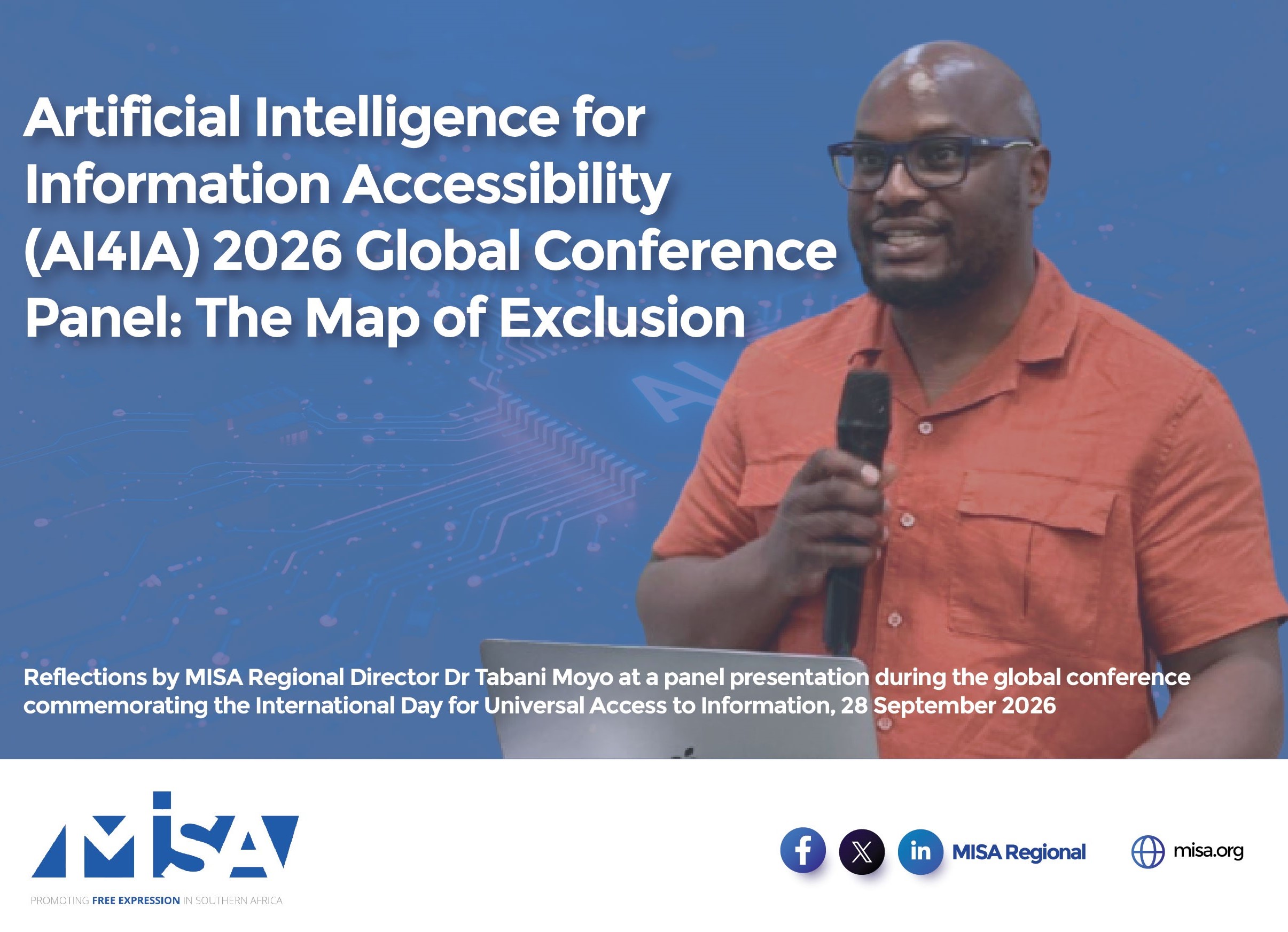
Reflections by MISA Regional Director Dr Tabani Moyo at a panel presentation during the global conference commemorating the International Day for Universal Access to Information, 28 September 2026
The diversity of this group is intended to reflect the complexity of the subject matter itself, but of course bearing in mind that this cannot be exhaustive.
What we can do, however, before handing over to colleagues who will each walk a narrower and deeper path than I have time for, is to draw the map they’re walking on.
Start with the assumption that most policy language treats as settled: that connectivity entails access. It doesn’t. A household with a signal is not the same as one using that signal to do anything that changes its position in the world.
There is a difference between being connected and being actively connected.
The third category policymakers rarely name at all: being that negatively connected, present on a network as a data point, a subscriber, a body to be counted towards a coverage target, while the terms of that presence are set entirely elsewhere.
Coverage maps count towers. They don’t count agency. A country can meet its connectivity targets and still have a population that experiences the network primarily as something done to them rather than something they use.
That distinction only holds if we’re willing to map inclusion in layers, because it isn’t one thing. The bottom layer is physical and unglamorous: electricity, the critical minerals that go into the devices and the batteries, and the hardware supply chains that most digital-inclusion frameworks quietly assume have already been solved.
Above that sits the question of speed and quality, and here I want to push back on a framing I hear constantly, which treats bandwidth as an entertainment metric: can you stream, can you scroll?
Information work asks something different from a connection than what video does. Verifying a claim, cross-referencing a document, and participating in a proceeding that requires you to load and read primary material rather than a summary needs a different quality of connection than passive consumption does.
The need itself is downstream of legislative choices about what counts as adequate service. A regulator who defines “connected” at a speed sufficient for a phone call has made an information-access decision without naming it as one.
None of this resolves cleanly into a binary of inclusion or exclusion. It’s a process, and it depends on factors that sit well beyond the access-and-connectivity conversation we usually have.
This is about affordability, which is its own layer, and availability, whether the material exists in your language and whether the legal framework lets you act on it once you’ve found it.
This is why I’d ask us, across the sessions ahead, to peel the onion rather than accept the slogans at face value. “Leave no one behind.” The “last mile” of connectivity.
A Digital Compact oriented towards voice. People-centred connectivity, quality of conversation, agency. These are the right ambitions.
Each of them, is doing a lot of work to compress layered, contested processes into a single clean phrase, and the exclusion that survives beneath the phrase is exactly the exclusion we’re here to find.
Here is the layer I think this field still under-names: access to information is never neutral, because someone curates it, someone governs the terms of that curation, and someone owns the pipes it travels through.
Media houses and civic institutions are not neutral conduits between information and the public. They are infrastructure for agency, built with editorial choices, ownership structures, and legal exposure baked in.
Much like a road is infrastructure built with choices about which towns it connects and which it bypasses. Pretending otherwise is how policy ends up protecting the pipe while ignoring who controls the valve.
That problem grows sharper, not softer, once AI enters the picture. A system trained overwhelmingly on Global North data, in a handful of dominant languages, and encoding a narrow set of institutional and cultural defaults, does not arrive as a neutral accelerant of access.
Left unchecked, it automates existing exclusion at a scale no single curator or gatekeeper could previously manage. So the real question underlying “AI for access” is a governance question>
Who is actually in the room when AI policy and information law are written, and whose realities are quietly encoded as the default case, with everyone else treated as a deviation. Sovereignty and information accessibility are not two subjects that happen to be adjacent. They are one subject.
That’s the map. What the colleagues after me will do is walk the specific terrain within it; literacy and education, disability, gender, among others, each revealing a different shape of the same exclusion I’ve just sketched in general terms.
I’d ask that we hold one discipline in common as we move through those sessions: nothing about the excluded should be designed without the excluded. Not consultation after the design is fixed.
Co-design, from the start, as the ordinary way of working rather than the exceptional gesture that is the difference between charity and a seat at the table.
IFEX’s contribution to this field, through the Collaboration Framework and Principles, has been to consolidate solidarity and genuine collaboration among its members rather than allow each organisation to defend its own patch.
IFAP turns 25 this year, and that is precisely the spirit its next chapter needs, carried outward from the press-freedom networks that built it towards the whole information-accessibility community now in this room.
We have the map! What happens next depends on whether we’re willing to walk it together.
UNESCO organised the virtual meeting, which this year commemorated seven years of AI4IA and 25 years of the Information for All Programme (IFAP).
Dr Moyo was on the panel with Nashilongo Gervasius, Director for Corporate Engagement, Partnership & Internationalisation (NUST, Namibia); Dr Roana Williams, Lecturer and Graduate Program Coordinator – MA Leadership in TVET & Workforce Development (University of West Indies [UWI]).
Other panellists were Dr David Akpan, Deputy Director – Partnerships & Programs, eHealth Africa; and Rym Badran, Founder (Girl Up, Lebanon).
The panel was moderated by Andrea Millwood Hargrave, Principal, Millwood Hargrave Ltd; FRSA
MISA Regional Communique